
If you couldn’t tell from the bazillion posts about The Seawolves, we’re kind of obsessed. So much so that we took to the field with our friends over at Explore Seattle Southside to get an up close and personal look at this incredible sport. Read up on the experience and get amped for the start of the 2023 season.
“You’re not afraid of heights are you?”
Not exactly the type of reassurance I was looking for after just volunteering myself to be vaulted fifteen feet in the air by two giant strangers who tackle other giant strangers for a living. That didn’t matter though. Before I could think it through, they grabbed my legs, lifted me up, and signaled for another giant stranger to throw a rugby ball towards my face. Reacting more on reflex than skill, I instinctively reached out and caught the ball just before impact. Overjoyed that I avoided catastrophe.
“Nice catch, ” the coach congratulated me as I landed back on my own two feet.
“But you forgot to pass it to the nine.”
Communication is everything in rugby. Kees Lensing, lead performance analyst for the Seattle Seawolves, will be the first to tell you that. He takes no restraint in reminding everyone of this essential aspect of the game he loves. Originally from Namibia, Kees has traveled the world as a professional rugby player and coach. He appeared in two world cup events and was captain of the Namibia national team for a number of seasons. Nowadays, Kees is helping lead the Seawolves to Major League Rugby championships while also helping educate the general American public on this exciting game.
As part of their initiative to grow attendance and local interest in the game, Kees, along with Seawolves head coach Allen Clarke, invited folks from Explore Seattle Southside and Experience Tukwila to come learn the ins and outs of rugby and share it with our audiences. A chance to play rugby with professional rugby players? It was a no-brainer.
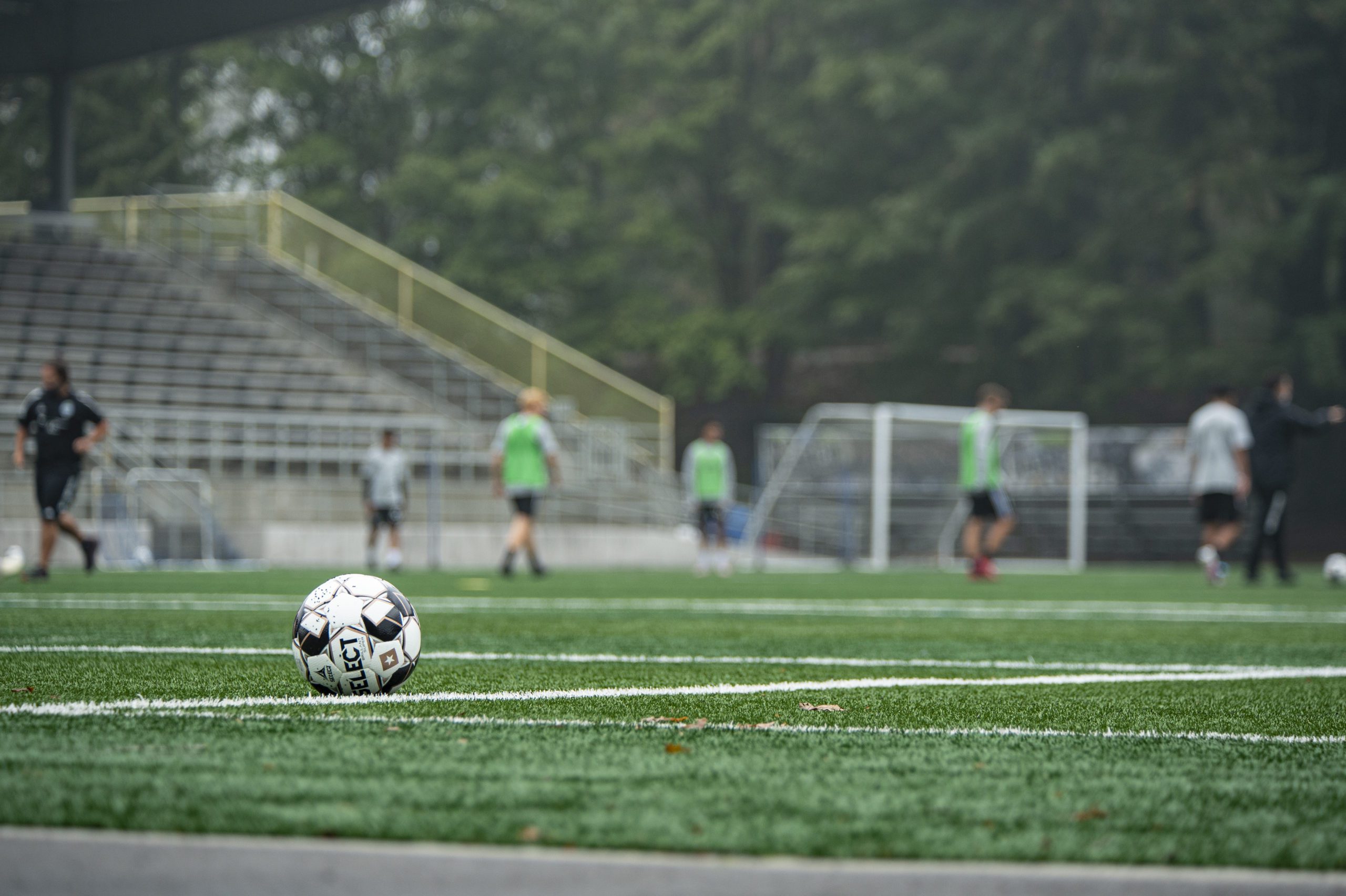
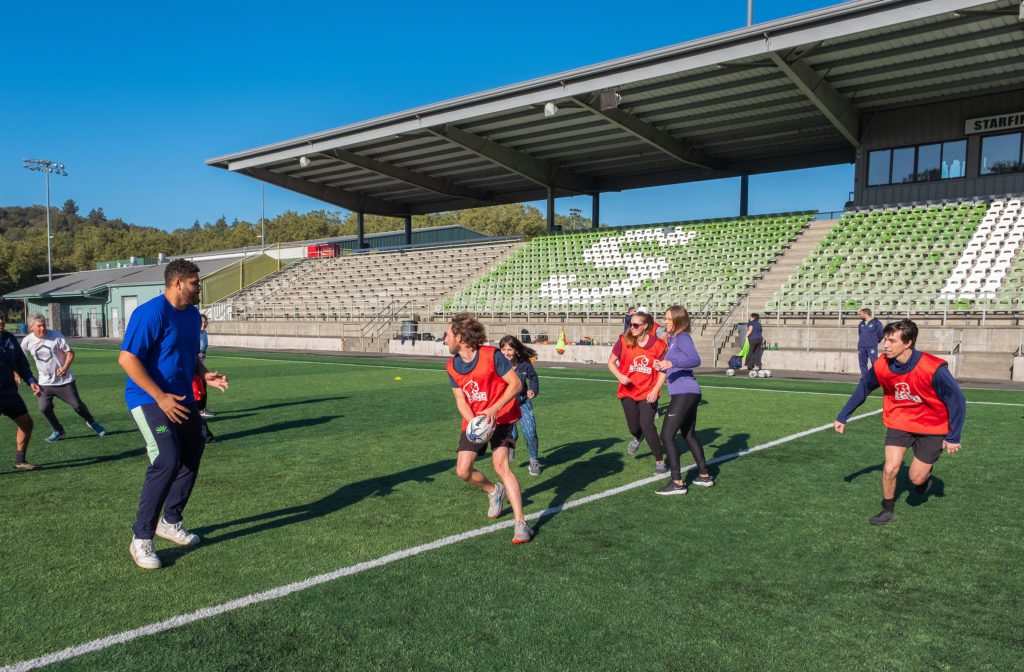
On an unusually sunny and warm morning, we met out on the Starfire pitch, most of us without a clue of what to expect next. After introductions and a brief overview of rugby basics, the whistle blew and we set off back and forth across the grass going through a variety of warm-up drills. Talking about rugby is one thing, but to truly understand what the game is about, you need to dive in head first.
The coach tossed us a few rugby balls and told us to partner up.
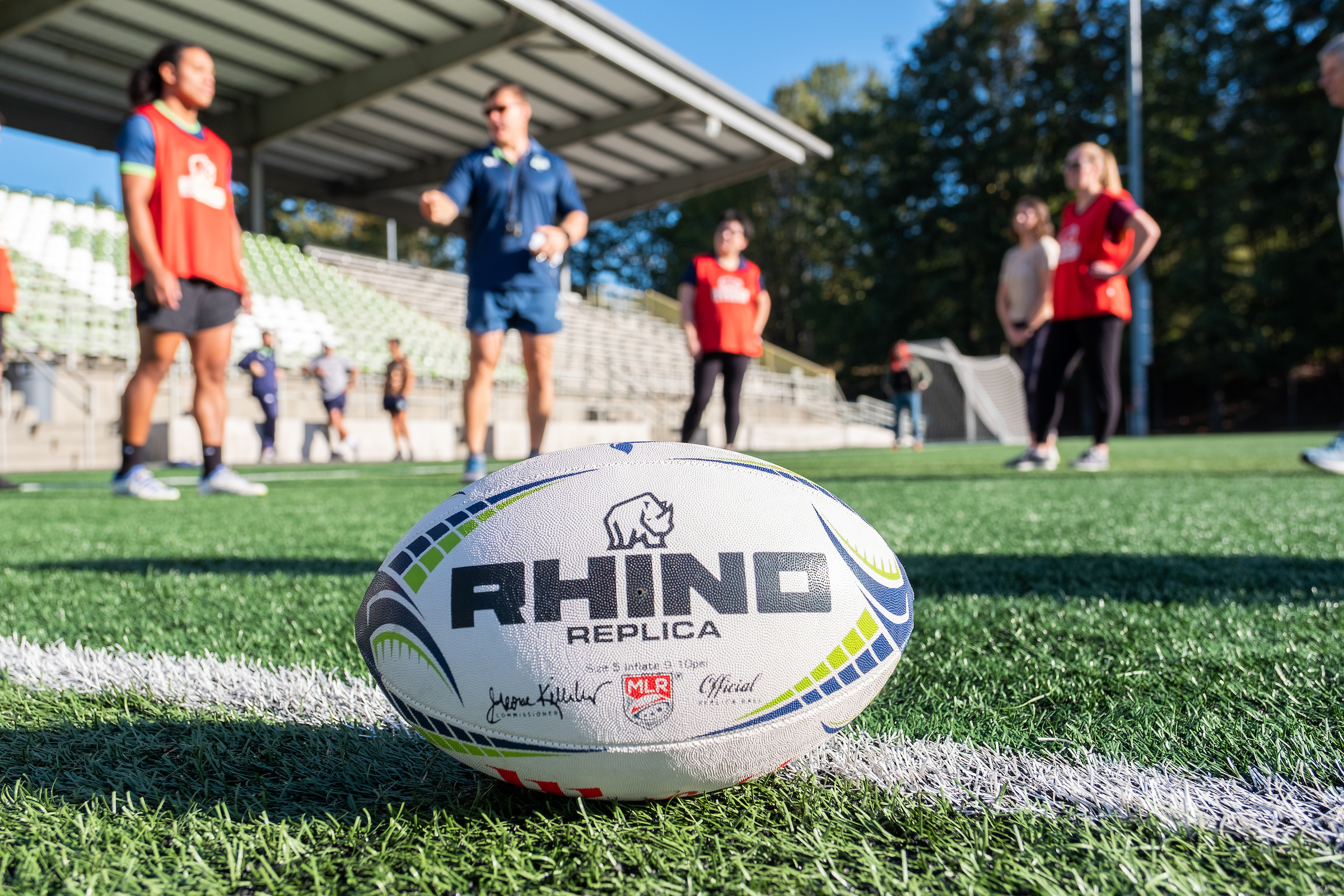
I linked up with one of the Seawolves players and got a crash course in spin passing. What looks like a pretty simple motion from afar is actually much more technical than I expected. When you pass in rugby you have to essentially lob the ball to your teammates, but it has to be either a diagonal pass or a backward pass; forward passes are not allowed. After struggling to get a proper spin on the ball while tossing to my right, we switched sides and that’s when it all started to click. Tossing a rugby ball feels very foreign, especially for someone who grew up in a state where football reigns supreme. It’s almost twice the size of a football and less angular, almost like tossing some kind of hollow gourd. Once you get the hang of it and nail that perfect spiral it’s surprisingly fun, and I would have been totally satisfied just tossing the ball back and forth for the remainder of the morning. But that wasn’t the plan.
The whistle blew again and now came our ultimate test—a real rugby match. Well, not exactly a real rugby match, more like a truncated version of rugby without the tackling and organized play structure. But it was the perfect way to get a feel for the flow of the game. In rugby, it’s all about constant movement. Playing this simplified version of rugby is meant to encourage new players to always be on the move, to feel the rhythm of tossing, catching, and running. As we scrambled back and forth across the pitch, I quickly gained an appreciation for the no-overhand throwing rule. Lobbing the ball to teammates requires you to be much more creative with your passing. You have to find clever ways to thread the needle between the sea of players.
After the final score, or as they call it in rugby, the final “try,” it was time to gather round and learn a little more about what actual rugby gameplay involves. So let’s walk through some of the highlights and learn a little rugby 101 terminology:
Scrum
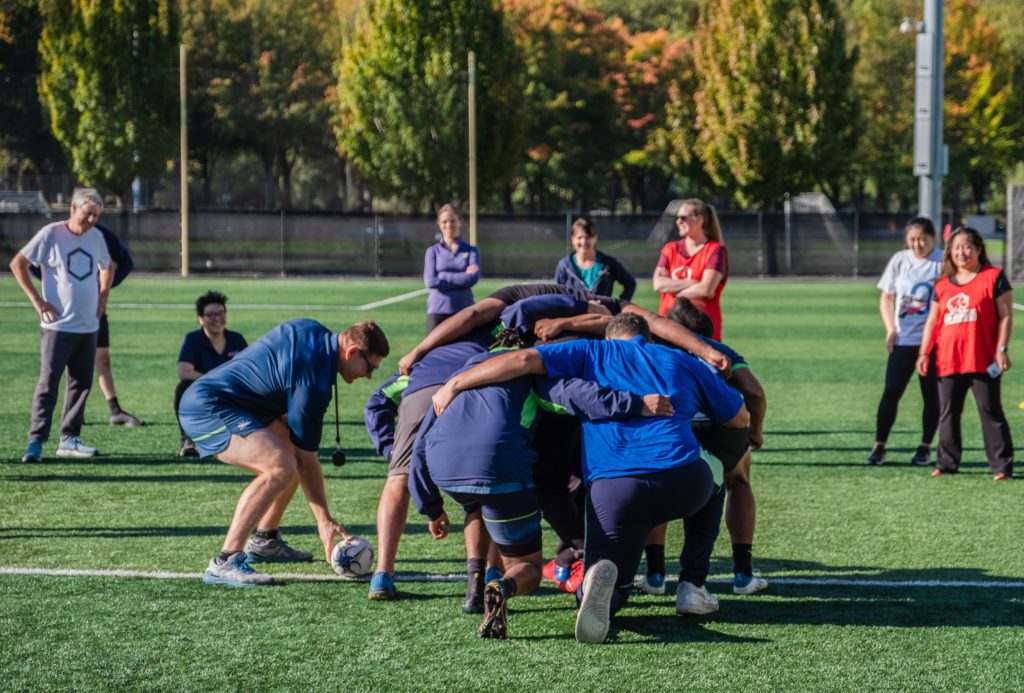
First up was the “scrum.” Kees called on a few Seawolves players and within moments they were locked together arm in arm in a mass of muscle. You’ve probably seen the sight before, two walls of players pushing against each other with incredible force. A scrum is one of the defining characteristics of rugby. Similar to a faceoff, once the two groups are pressed against each other, another player rolls the ball underneath the web of bodies. A player called a “hooker” then uses his feet to grab the ball like a hook and kick it back toward the rest of his team. According to Kees, at any one time during a scrum, the hooker is experiencing upwards of 2,000 lbs of force per square inch on their upper body. With all that force focused on one person, it’s imperative that the other players are there to support. That’s what the majority of the players in the scrum are there for. It takes a horde of people just to protect the hooker as they fight for possession. For obvious reasons, we were not asked to participate.
Breakdown
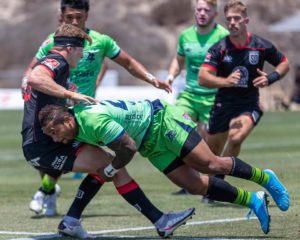
Next up was the “breakdown.” A breakdown occurs immediately after a player is tackled and requires rapid-fire reflexes from both teams. The player who is tackled must remain on the ground with the ball and the player who tackled must roll to the side out of the way. Then it’s up to other players from both teams not involved in the initial tackle to rush toward the down player and attempt to get the ball. The down player attempts to contort their body in such a way that protects the ball from the defensive players while providing an opening for their teammates to grab it. But the offensive players can’t simply run to the downed player from any direction, they must enter through a tiny invisible area called the “gate” which is defined by the position of the downed player’s body. Offensive players enter through this small area and quickly set up a wall on the downed player, protecting the ball from the opposition and allowing for another player to snatch it up and return to play. If the defensive players get to the downed player first, then they can grab the ball, resulting in a turnover. Confused yet? It’s honestly much more intuitive than it sounds. But apparently, there are even more rules/details about the breakdown that Kees wouldn’t get into because of the complexity. All in all, though, it’s a really impressive display of strategy and muscle.
Lineout
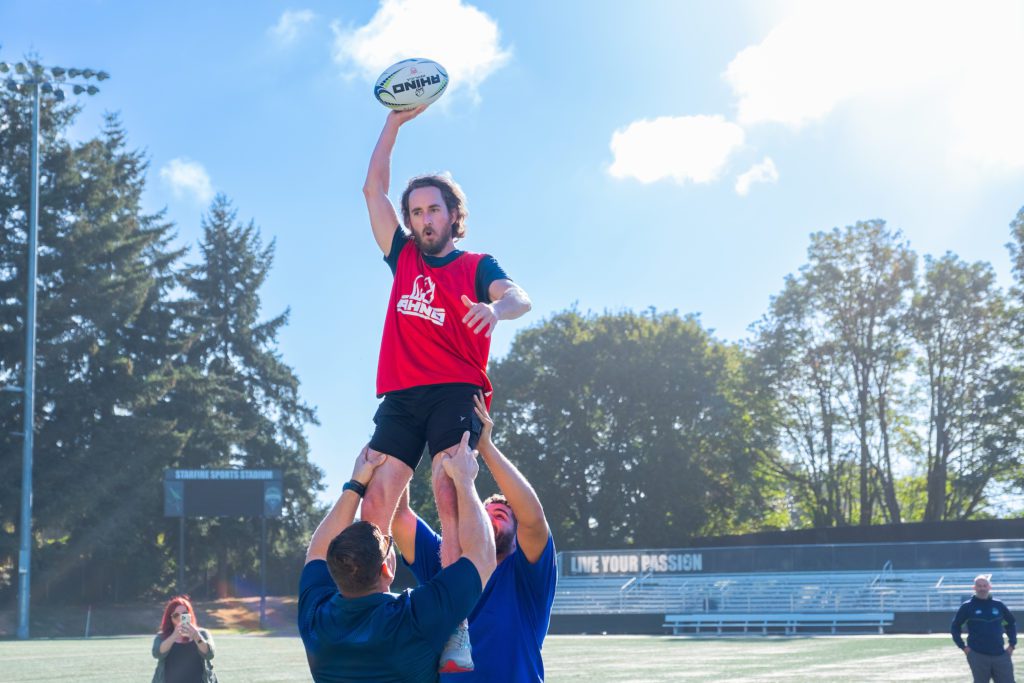
Lastly was the “lineout.” The lineout is a way of returning the ball into play after it has gone into touch, or what we usually understand as “out of bounds.” This involves a player simply passing the ball into play. One of the most popular methods to receive the ball is to lift a player high into the air out of reach from the defending team. Once again, Kees wrangled a group of Seawolves players to show us how it was done. After running through the routine a few times, Kees asked for volunteers. Realizing that I might not ever get this opportunity again, I raised my hand and took the chance. The Seawolves players lifted me up and tossed the ball. It sounds stupidly simple, but it was actually a pretty disorienting experience. It wasn’t so much a lift into the air as it was a push into the air, almost like a cheerleader jumping up and being held by their feet. Add in a rugby ball spiraling towards your face, plus a group of strangers watching you from below, and it quickly becomes a high-stress moment. What you’re supposed to do after catching the ball is toss it out to an open player. But I simply held onto the ball and celebrated the fact that I both caught the pass and didn’t topple over in the process. After explaining the expectations again, Kees let me go for a second attempt, this time completing a proper pass to the outside player. Go me!
After finishing up the demonstrations, Kees and the rest of the staff took a moment to explain the many benefits of rugby for communities. “No matter what happens out on this field, I have never left it feeling sad,” Kees explained. Beyond the many fitness benefits of playing the high-intensity sport, rugby also provides a strong sense of connection and camaraderie for players—a key characteristic which Kees sees as necessary personal armor against mental health issues. He, along with the rest of the staff, hope to see the sport grow in not just Seattle, but the entire country, to help provide kids with a hobby that can lead to lifetime friendships as well as provide endless high-action entertainment for sports fans.
The 2023 MLR season is just around the corner and the Seawolves are poised for another dominant year out on the pitch. Don’t miss out on viewing this exciting game before it inevitably blows up across the country. That way you can say you liked rugby before it was cool.
All images courtesy of Explore Seattle Southside.



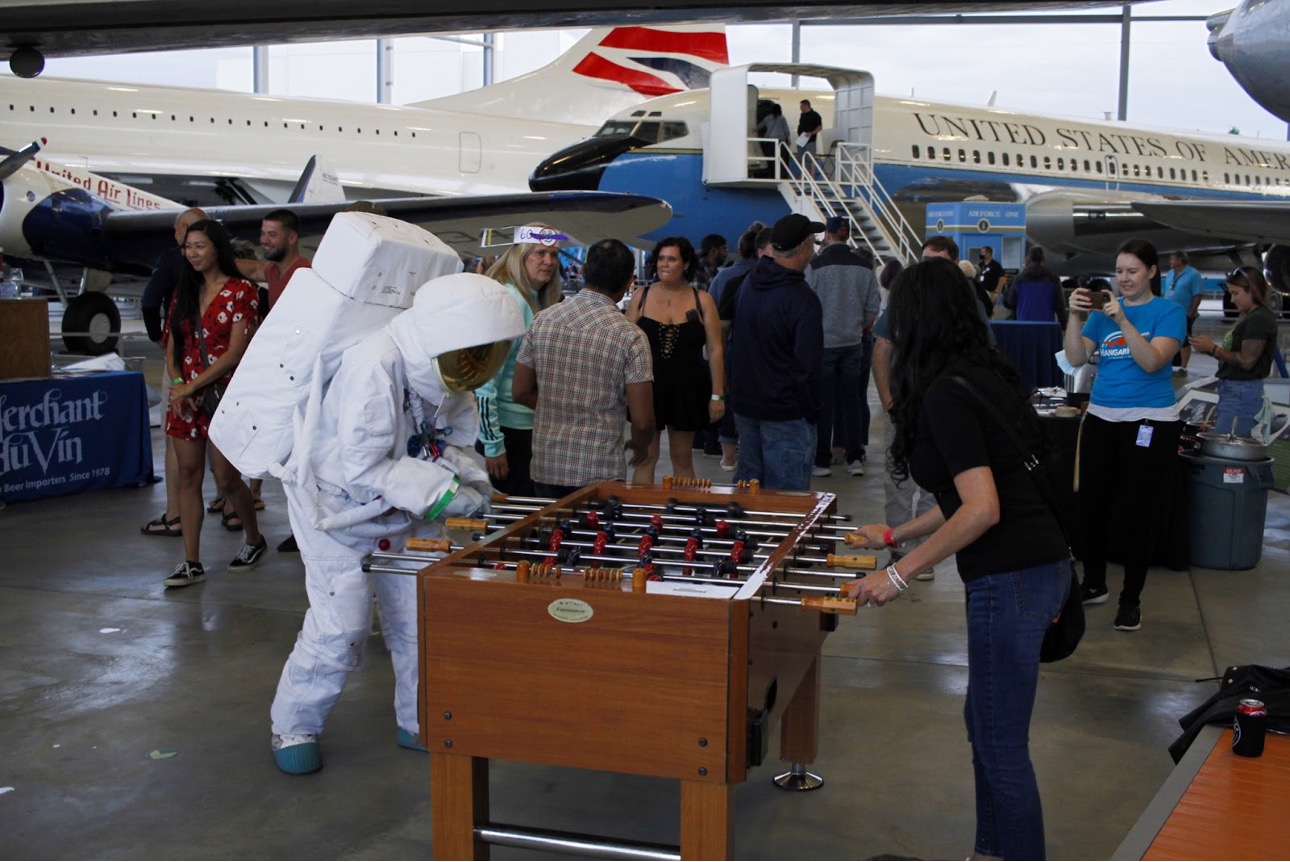
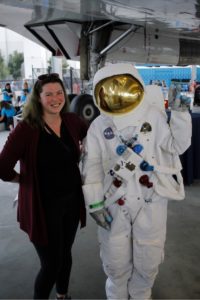
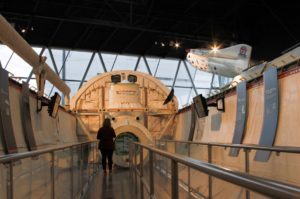 On a cool Saturday evening, we made our way to The Museum of Flight for HangarFest. While not my first time at the museum, I was excited to realize that the “hangar” in HangarFest meant that I got to visit an area I’ve never been before: the Charles Simonyi Space Gallery and Aviation Pavilion! We made sure to get there early, so we would have time to check out the displays and interactive exhibits before the main event.
 Around 7:00, we made our way out to the hangar for the start of the festivities. The Aviation Pavillion is a more recent addition to the Museum of Flight, having opened in June of 2016, and highlights the drastic development aircraft and commercial airlines underwent from 1930 to today. The three-acre lot features over 15 airplanes, several of which visitors could walk through, from nose to tail.
 Provided throughout were outdoor games, like cornhole, giant Connect 4, foosball, and giant Jenga; as well as a craft station and photo booth. Outside the hangar, there were a half dozen food trucks, with such tantalizing options that we couldn’t choose just one. We ended up trying a Lumpia plate from the Big Boys Kainan Filipino food truck, based out of Kent, and a chicken cordon-bleu savory meat pie from 314 Pie, which you can find in a variety of locations up and down the I-5 corridor. When I asked how business had been for the event, he simply grinned and gestured at all the empty pie trays on his table.
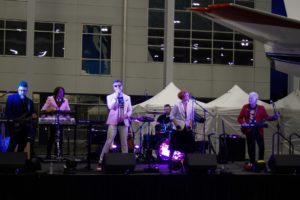 Back in the hangar, Prom Date Mixtape was blasting a very 80s cover of “Sunglasses at Night” as we made our way inside a hulking 747. Inside, there was a peek-a-boo floor down to the inner workings below.
 We rounded out the night stopping at Letterpress Distilling. The distributor was thrilled for us to make him our last stop before last call. Sipping on a smooth glass of Amaro Amorino Riserva, we took in the last of a night that was nothing short of delightful. It was shocking to think of how little people know about HangarFest. As we look forward to next year’s event, I’m having difficulty deciding whether I want to keep it a secret or invite everyone I know to this party in the “sky.”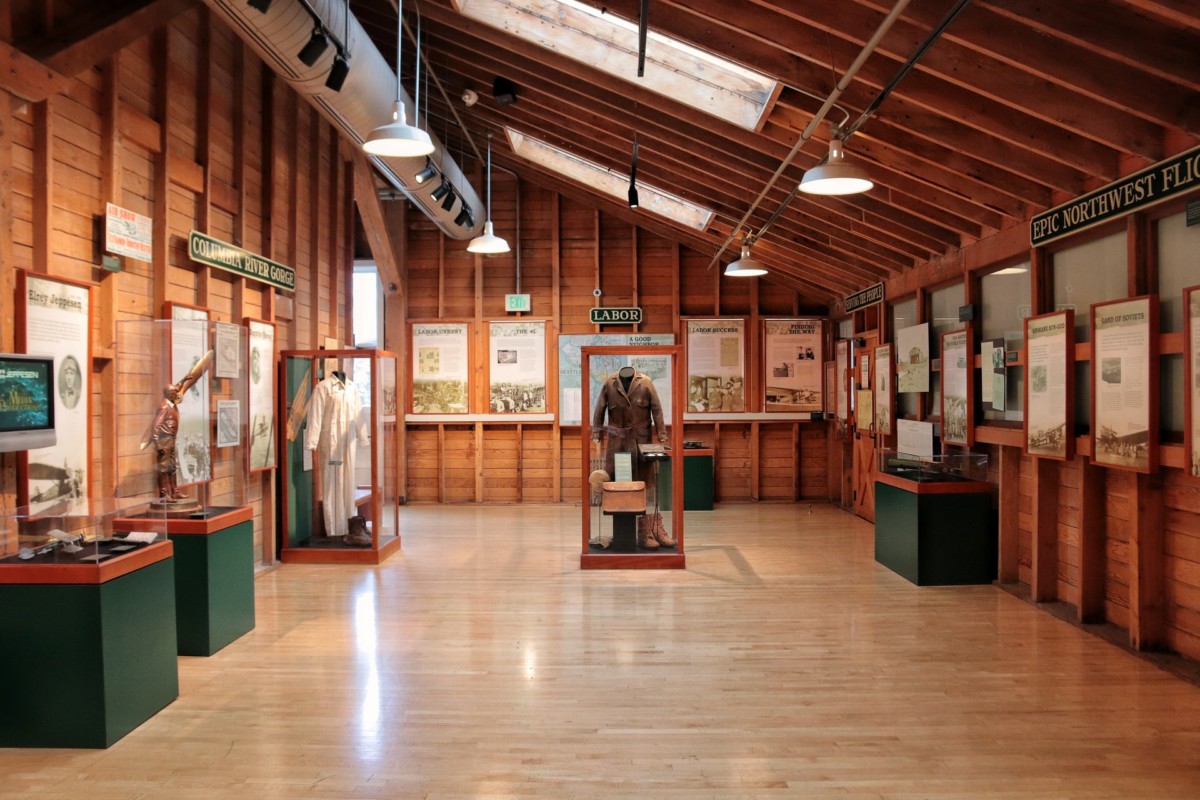
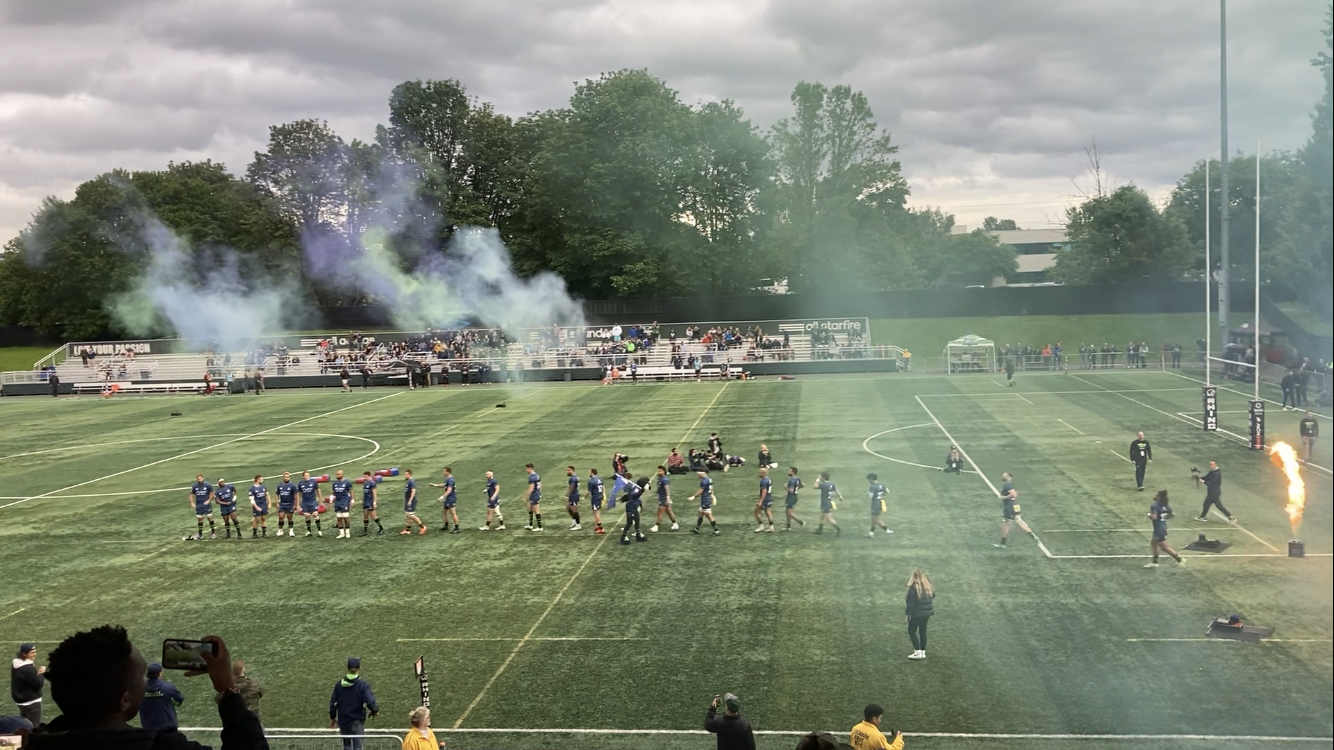
 Before I knew it, we were inside the stadium. But something about that distinction didn’t feel right. Unlike most sports venues, there wasn’t a clear boundary between inside and out. The grounds felt open and fluid, almost indistinguishable from the surrounding neighborhood. This feeling extended to the Starfire staff themselves, with ticket sellers, concessions operators, and merch vendors all operating like a tight community—like they knew each other well beyond their occupations. After exploring the merch tents, we grabbed ourselves a couple of drinks and a giant pretzel for pennies on the dollar and headed for our seats.
 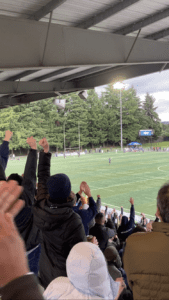 The match began with a flurry of action. Their opponent, the San Diego Legion, took an early lead, making a try just a few minutes into the first half. Even as a new fan my heart sunk, worried that this could spell the beginning of a long and painful night. But the Seawolves answered back and then kept answering back. Soon they were ahead with what felt like a comfortable lead heading into halftime. I hesitated to get too excited though. Superstitious tendencies from my days religiously following my favorite hockey team bubbled to the surface. Just 40 minutes into my time at Starfire and I felt a connection with the sea of green and blue filling the stands, and I hesitated to say anything that might jinx the game.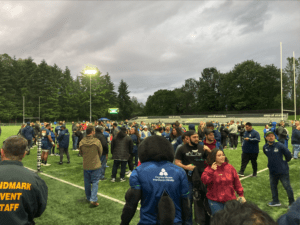
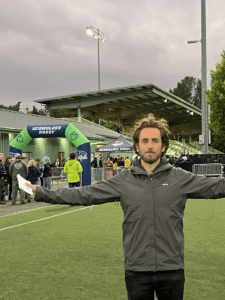 After we made our way back through the parking lot, I worked my way through memories from the night. I tried parsing out the moments, segmenting the groups of fans, sectioning off chunks of time in an attempt to more easily understand the night. But this felt counter to what I had just experienced. It quickly became evident to me that what separated watching a Seawolves match from other pro sporting events was its very lack of separateness at all levels. From the openness of the stadium to the interaction between players and fans, there was no clear beginning or end to the Seawolves experience. The Seawolves are a team within a family, within a community; there is no division; there are no distractions. This is sport at its essence.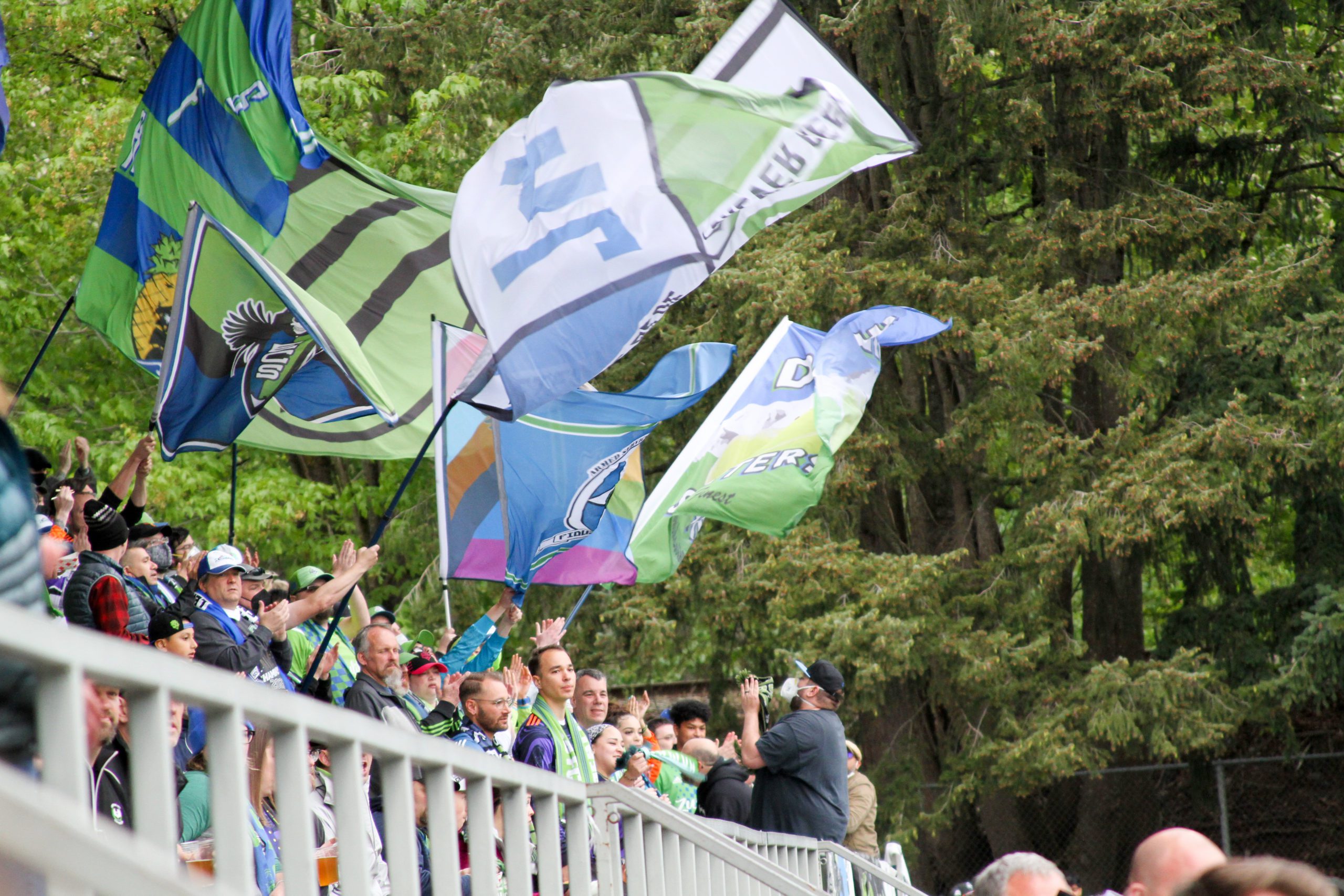
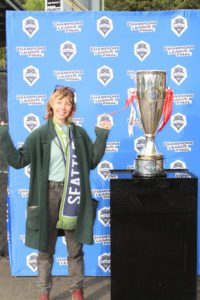 Waiting in line to pose with the recently-won CONCACAF Cup, we spoke with an old-school Sounders fan from Spanaway, Joseph Lieu, who loved Starfire games because “it’s much better and way easier to meet players than at Lumen Field. There’s more room to stand and meet and talk to the players one-on-one after the game. That’s how I met the entire team 8 years ago.” It is because of growing up going to Starfire games that Joseph is now going through school to become a sports photographer.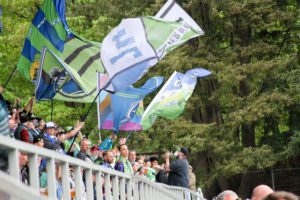
 Flash-forward to the end of overtime and neither team managed to score a goal. This meant time for penalty kicks—each team gets five penalty kicks, and whoever has more at the end takes the game. The rain had let up by this point, but the 2+ hours of play had taken their toll on the players. But their determination seemed to be in equal measure, as they ended the 10-total penalty kicks still locked in a tie. Next stop, “sudden death.” Each team kicks, and if one gets a goal and the other misses, it’s all over. Both teams go through player after player, making every goal in perfect synchronicity. Each player can only kick once, and they do. After 10 players from each team have taken their kicks, the Sounders and San Jose Quakes have each only missed one, two and a half hours after they took the field, at 9-9. The last players to attempt the kick are the goalies; who previously had been trading off guarding the net, now turn to face one another. The Sounders keeper, Stefan Cleveland, shot first. Unfortunately, unable to make the switch from saving to scoring, his kick was low and the San Jose goalkeeper Matt Bersano dived on the ball and made the save. Then they switched, Bersano squaring off against Cleveland. The crowd inhaled together.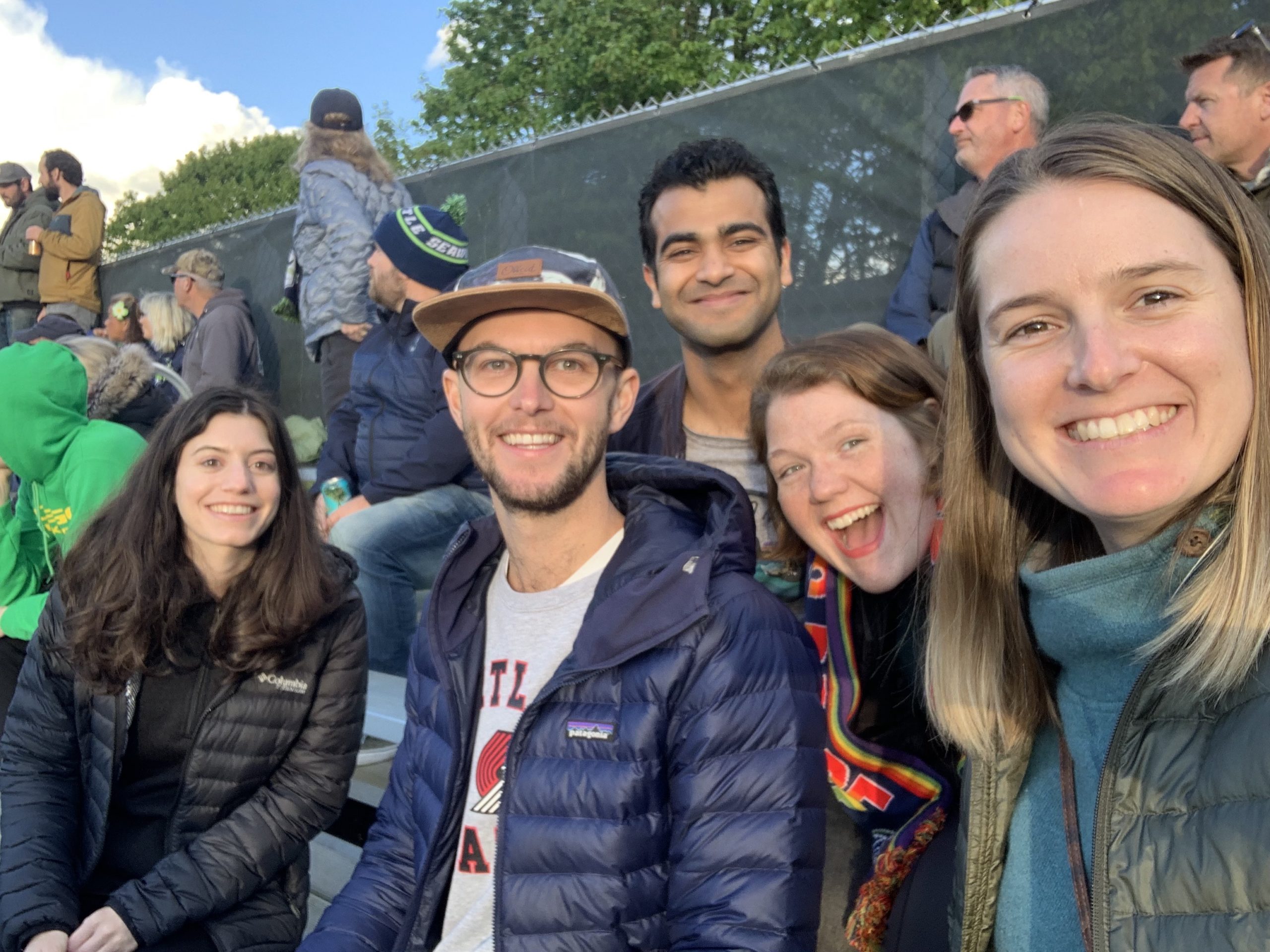
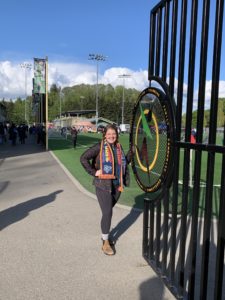
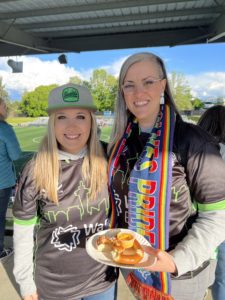 People keep steadily coming in and make their way to their seats. I head upstairs to grab myself a beer ($7 for stadium beer? I’ll take it!). When I get up there I see two women dressed head to toe in Seawolves gear. They look legit and one girl is eating a soft pretzel so I decide to approach. Their names are Mikaela Mattes and Kate Crabtree, it turns out they host the
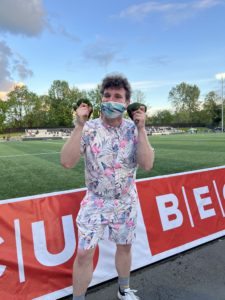
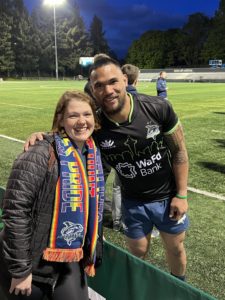 Players from both teams are approaching the fence to greet the fans and thank them for